
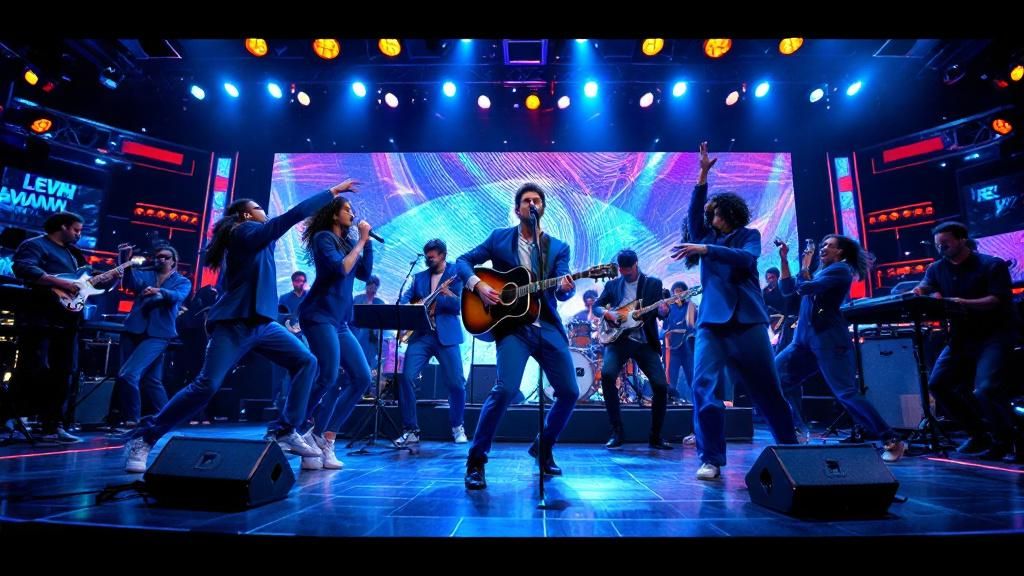
David Byrne brought dynamic theatrical flair to The Late Show on 31 March, performing a striking performance of “When We Are Singing” featuring Stephen Colbert. The Talking Heads lead vocalist, joined by a collective of blue-clad musicians and dancers, displayed the full choreographic vision that has established itself as his trademark. The track hails from his latest album, Who Is the Sky?, issued in September 2025. During his performance, Byrne outlined his conscious move towards vibrant, visually engaging presentations and explained his strategy to combining solo work with classic Talking Heads hits on his current tour, including “Psycho Killer” and “Life During Wartime,” whilst preserving artistic integrity.
A Dramatic Return to Late Evening Television
Byrne’s feature on The Late Show constituted a remarkable demonstration of his emerging artistic perspective, one that prioritises spectacular visuals and precise choreography. The performance of “When We Are Singing” illustrated his willingness to approach songwriting with clever self-consciousness, extracting comedy from the unusual facial movements singers necessarily make during live singing. When exploring his creative decisions with Colbert, Byrne displayed an quasi-scholarly interest about the fundamentals of singing itself, noting how performers’ open mouths create an ambiguous expression that could signify either profound pleasure or basic physiological requirement. This thoughtful strategy to artistic performance distinguishes his work from standard popular entertainment.
The aesthetic evolution evident in Byrne’s current tour demonstrates a conscious abandonment of his earlier monochromatic aesthetic, a deliberate decision stemming from current societal requirements. He outlined a coherent philosophy: the times demand colour and visual energy rather than stark minimalism. This change reveals Byrne’s attunement to the psychological environment of his listeners and his recognition that stage design expresses meaning as effectively as words or music. By partnering with his blue-clad ensemble, Byrne has developed a unified visual vocabulary that complements his musical exploration whilst conveying an positive, future-oriented creative position.
- Byrne deliberately selected “When We Are Singing” to underscore absurdity of facial expressions
- The ongoing tour showcases vibrant blue costumes substituting for previous grey visual design
- The show includes Talking Heads signature pieces paired with solo material from Who Is the Sky?
- ICE footage incorporated deliberately at end of “Life During Wartime” for effect
The Conceptual Framework Underpinning Who Is the Sky?
David Byrne’s latest album, Who Is the Sky?, released in September, represents a continuation of his enduring investigation into human conduct, perception, and creative expression. The record functions as a creative wellspring for his present touring venture, with “When We Are Singing” demonstrating his capacity for draw deep insights from everyday moments. Byrne’s method of songwriting remains distinctly intellectual, converting mundane observations into compelling musical narratives. The album’s thematic concerns—how we present ourselves, what our expressions reveal or conceal—shape every aspect of his live performances, creating a unified creative vision that extends beyond traditional album promotion into territory that is more philosophically ambitious.
The creative collaboration between the new material and Byrne’s reimagined concert aesthetic creates a cohesive experience for audiences. Rather than approaching Who Is the Sky? as simply another body of work to be performed, Byrne integrates its conceptual framework into the visual and choreographic dimensions of his shows. This holistic approach demonstrates his decades-long commitment to breaking down divisions between music, dance, and visual art. By choosing particular pieces like “When We Are Singing” for extensive stage adaptation, Byrne illustrates how modern composition can move beyond the recording studio and become fully realised performance art on stage.
Transforming the Concert Atmosphere
Throughout his career, Byrne has repeatedly rejected the concept of static, unchanging stage shows. His philosophy prioritises ongoing development and adaptation, treating each tour as an chance to reconsider how audiences should engage with music live. The shift from muted visual design to bold, vivid staging reflects this commitment to reinvention. Rather than drawing from backward-looking sentiment or established reputation, Byrne actively constructs fresh aesthetic vocabularies that complement his current artistic preoccupations, ensuring that his shows remain timely and powerfully moving rather than just revisiting the past.
Byrne’s collaboration with his ensemble of blue-dressed musicians and dancers represents a deliberate investment in choreographic storytelling. By partnering with skilled artists who understand both movement and musical vocabularies, he creates layered performances where movement, costume, and sound speak together. This multidisciplinary approach distinguishes his shows from conventional concert experiences, positioning them instead as immersive creative experiences. The integration of classic Talking Heads material paired with original compositions shows that reinterpreting need not involve abandoning one’s past—rather, it entails contextualising earlier work within new artistic contexts that respect their authenticity whilst exploring new possibilities.
Reconciling Tradition with Innovation
David Byrne’s approach to his catalogue reveals a refined comprehension of creative accountability. Rather than discounting his Talking Heads era or being wholly consumed by it, he has constructed a framework that enables him to honour the past whilst preserving creative autonomy. This balance requires deliberate curatorial choices—selecting which classic tracks warrant inclusion in contemporary sets, and how they should be situated within new artistic frameworks. Byrne’s willingness to perform “Psycho Killer” and “Life During Wartime” alongside solo material illustrates that legacy need not equate to stagnation or cynical backward-looking sentiment.
The concern Byrne points out—becoming a “legacy act that performs the old hits”—constitutes a genuine artistic trap that many veteran performers fall into. By strategically restricting his reliance on earlier material and continually reinventing creative direction, he preserves creative credibility whilst recognising his past. This strategy safeguards both his creative principles and his audience’s engagement, ensuring that concerts function as vital creative expressions rather than museum exhibitions. His unwillingness to commit to a full Talking Heads reunion further underscores his commitment to artistic evolution over financial expedience.
Talking Heads Material in Contemporary Setting
When Byrne delivers “Life During Wartime” today, the song holds distinctly modern resonance. By obtaining ICE footage to complement the track’s close, he transforms a 1979 post-punk anthem into a statement about present-day political realities. This curation—showing the imagery merely at the track’s finish rather than across the entire performance—demonstrates refined curatorial sensibility. The approach recognises the footage’s emotional resonance whilst avoiding the performance from turning excessively bleak or preachy, upholding the song’s artistic integrity whilst enhancing its present-day importance.
This contextualisation strategy extends beyond mere visual accompaniment. Byrne’s commitment to weaving Talking Heads material into his active ensemble’s artistic framework establishes creative conversation across temporal boundaries. The costumed performers and energetic visual presentation alter the way viewers encounter these familiar songs, removing sentimental assumptions and requiring genuine participation with their present-day significance. Instead of maintaining the songs locked in the past, this method permits them to evolve in fresh creative settings.
- Strategic incorporation of established material forestalls creative repetition and legacy-act status
- Visual recontextualisation strengthens contemporary relevance without undermining artistic authenticity
- Rejecting reunion permits Byrne to manage how and when Talking Heads material surfaces
The Foundations of Achievement
David Byrne’s strategy for live presentation goes well past simply playing songs—it constitutes a carefully considered artistic framework rooted in visual narrative and audience psychology. During his slot on The Late Show, he conveyed this perspective with distinctive care, describing how ostensibly everyday observations about human behaviour shape his artistic choices. His performance of “When We Are Singing” demonstrates this approach: the song stemmed from Byrne’s insight that singers’ open mouths during singing create an equivocal look—one that could indicate either profound ecstasy or mere physiological need. This dry observation transforms into stage material, demonstrating how Byrne draws from ordinary life for artistic material.
This philosophical framework extends to his broader approach to touring and stage design. Rather than approaching concerts as fixed renditions of recorded material, Byrne regards each tour as an occasion for total creative reinvention. His decision to infuse the present tour with colour—an intentional contrast to the grey visual language of his prior stage designs—demonstrates deeper convictions about art’s role in society. In his perspective, contemporary audiences facing uncertain times demand visual energy and colour abundance. This is far from being a stylistic preference; it reflects Byrne’s belief that live performance carries an obligation to uplift and energise, to provide sensory and emotional nourishment beyond the music itself.
Why Colour Is Important Now
Byrne’s clear declaration—”the times we live in, we need some color”—reveals how he positions creative choices within broader social contexts. The transition from grey towards vibrant blue-costumed performers and colourful staging reflects his belief that aesthetic choices hold political and emotional weight. This decision recognises current concerns and doubts whilst offering an antidote through chromatic abundance. Rather than withdrawing towards monochromatic austerity, Byrne insists that art should actively resist despair through its visual language, transforming the concert stage into a space of deliberate, necessary colour.
